

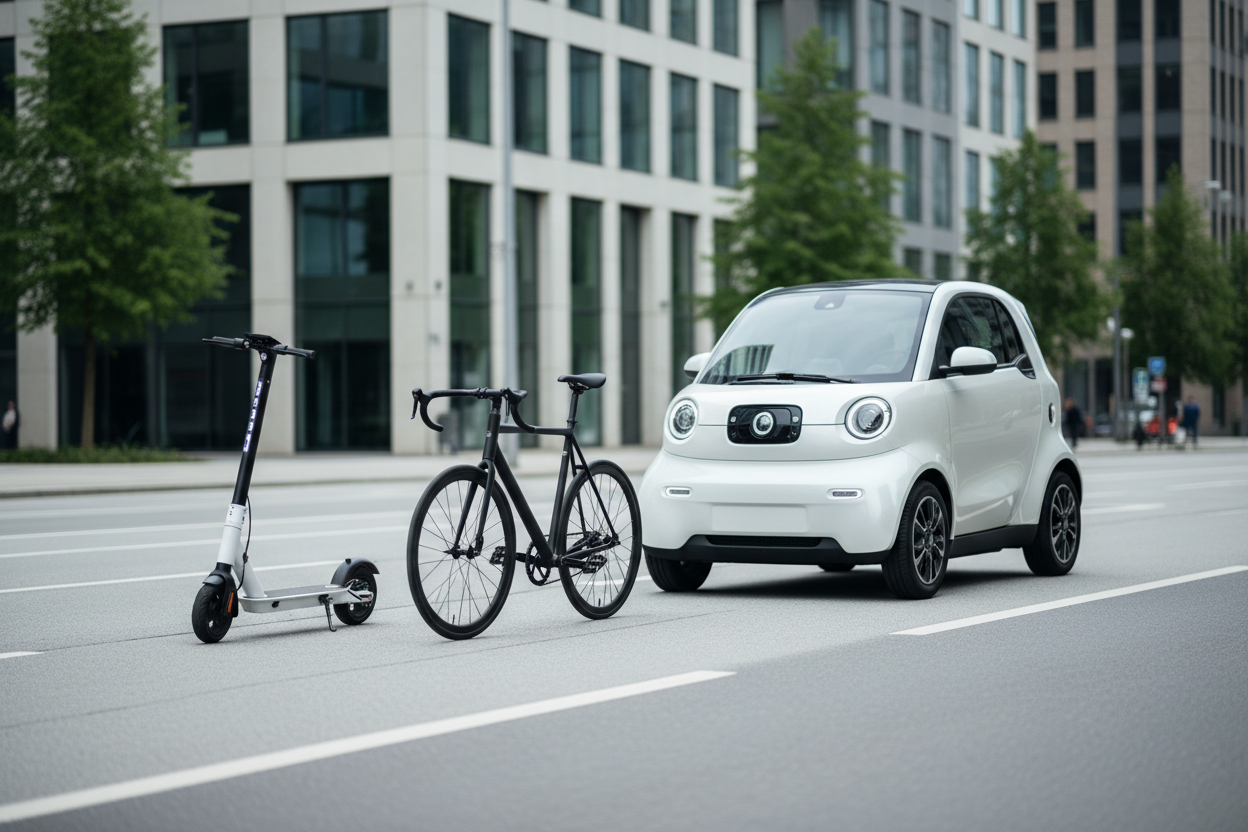
Mobility Bicycle, e-scooter or petrol engine
The right vehicle for every family member
Electric scooter (e-scooter):
Technology:
- Electric motor: E-scooters are powered by an electric motor that is powered by a lithium-ion battery.
- Battery: The battery stores the electrical energy. Modern e-scooters use light, long-lasting lithium-ion batteries.
- Controller: A control unit regulates the engine’s power output based on driver inputs.
Segway-Ninebot F2 Plus D, E Scooter with road approval for adults, max. 20 km/h, 55 km range, long range


Segway-Ninebot MAX G30D II, E Scooter with road approval for adults, max. 20 km/h speed, 65 km range, long range

Advantages:
- Environmentally friendly: No direct emissions, resulting in less environmental impact.
- Low operating costs: Compared to petrol-powered scooters, the operating costs for e-scooters are often lower.
- Quiet: Electric motors are quiet in operation, which leads to less noise pollution.
Disadvantages:
- Limited range: The range of an e-scooter is limited, depending on the battery capacity.
- Charging infrastructure: The availability of charging stations may be limited depending on the region.
- Purchase costs: E-scooters can be more expensive to purchase than petrol-powered models.
City Bike Electric
Another alternative is an e-bike like this City E-Bike . 25 km/h and 150 km range. An alternative to the car. 
Well secured with the e-scooter in the city

|
 |

|

|
Petrol car:
Technology:
- Internal combustion engine: Petrol scooters are powered by an internal combustion engine that runs on petrol.
- Fuel tank: The scooter has a tank for the engine’s fuel needs.
- Transmission: A transmission transfers the power from the engine to the rear wheel.
Advantages:
- Long range: Gasoline-powered cars can drive up to 1000 km without refueling .
- Fast refueling: Refueling with gasoline takes only a few minutes compared to the longer charging times of electric vehicles.
- Well-known technology: The technology of gasoline engines has long been established.
Disadvantages:
- Environmental impact: Combustion engines emit pollutants and contribute to air pollution.
- Higher operating costs: Gasoline-powered scooters typically have higher operating costs due to gasoline consumption and higher maintenance requirements.
- Noise: Combustion engines are louder compared to electric motors.
Electric car:
Technology:
- Electric motor: Electric cars are powered by electric motors.
- Battery: A large battery stores electrical energy that drives the electric motor.
- Charger and inverter: A charger converts alternating current into direct current to charge the battery. An inverter controls the power output of the motor.
Advantages:
- Environmentally friendly: Electric cars do not produce any direct emissions during operation.
- Lower operating costs: Electric cars generally have lower operating costs per kilometer.
- Quiet: Electric motors are quiet in operation, resulting in a smooth driving experience.
Disadvantages:
- Limited range: The range of electric cars can be limited and depends on the battery capacity.
- Charging infrastructure: The availability of charging stations may vary regionally.
- Purchase costs: Electric cars are often more expensive to purchase than comparable petrol-powered vehicles.
Electric bicycle (E-Bike):
Technology:
- Electric motor: E-bikes are supported by an electric motor, which is usually integrated in the bottom bracket or the rear wheel.
- Battery: A battery stores electrical energy that supports the electric motor.
- Control system: A control system regulates the assistance of the electric motor based on the driver's pedal force.
Advantages:
- Pedal assistance: E-bikes offer pedal assistance, which makes cycling easier, especially on inclines or longer distances.
- Environmentally friendly: E-bikes have a smaller ecological footprint than motorized vehicles.
- Health benefits: E-bikes promote physical activity and are suitable for people who may have difficulty cycling due to health problems.
Disadvantages:
- Limited range: The range of an e-bike depends on the battery capacity and the intensity of the support.
- Weight: E-bikes are often heavier than conventional bikes due to the additional

Written by Sabine Mohr



Leave a comment
This site is protected by hCaptcha and the hCaptcha Privacy Policy and Terms of Service apply.